Make a Submission
| P-ISSN | E-ISSN |
|
|

Journal Of Lentera Education and Culture (LENTEC) implements that each accepted manuscript will go through a review process by the Editor and reviewers, using a Double Blind Peer-Review Process, in which the reviewer does not know the identity of the author, and the author does not know the identity of the reviewer.
Journal Of Lentera Education and Culture (LENTEC) applies a Double Blind Peer-Review policy. Every manuscript received will be sent to reviewers registered in the Journal. The review process lasts for a maximum of thirty (30) days, with each reviewer given up to ten (10) working days to complete their review. If a designated reviewer cannot complete the review within the specified time limit, the Editorial Board Chair will appoint a replacement reviewer.
In the review process, reviewers provide considerations regarding the compatibility between the title, abstract, introduction, discussion (results), and conclusion. In addition, reviewers also assess the novelty, scientific impact, and appropriateness of the references used.
Review Process:
Final decisions regarding article acceptance are made by the Editors based on reviewers’ comments. The publication sequence and arrangement of accepted articles are determined by the Editor-in-Chief, considering the acceptance date and geographical distribution of authors.
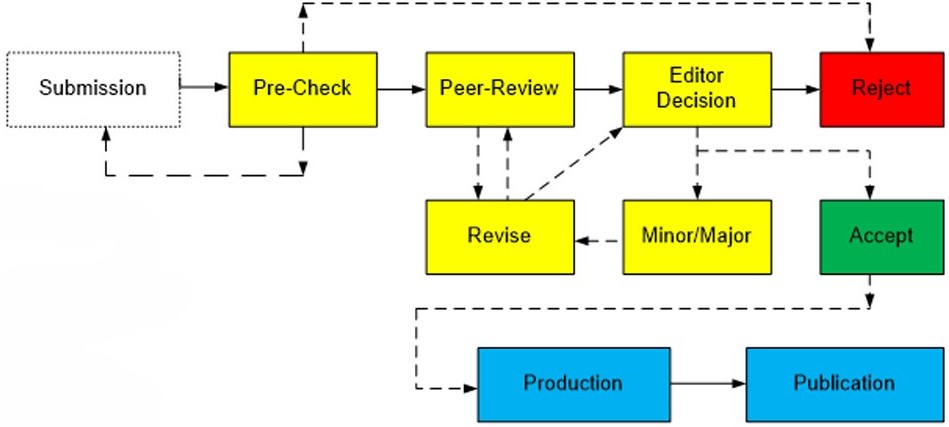
Detailed Explanation of Each Step:
Submission: The author submits the manuscript to the editor, electronically or by mail. The editor reviews the manuscript to determine if it fits the journal’s scope. If not, it will be rejected.
Pre-check: The editor checks for completeness, formatting errors, plagiarism, and ethical compliance. Manuscripts not meeting these standards are returned for revision.
Peer Review: The manuscript is sent to two or more reviewers for assessment of originality, scientific merit, and clarity. Reviewers may suggest changes, and the editor decides based on their feedback.
Editor Decision: The editor decides to accept, reject, or request revision based on reviewers’ feedback. Accepted manuscripts proceed to production; rejected ones are notified; revised ones are resubmitted.
Production: Accepted manuscripts go through formatting and layout by the production team, which includes adding tables, figures, and proofreading for final publication quality.
| P-ISSN | E-ISSN |
|
|







Published by :
PT JAYANA LENTERA SUGIANTORO
DIVISI LENTERA PUBLISHING
Address : Jl. MT Haryono 31 C Ploso Pacitan
E-Mail : lentec@gruplentera.com
HP/WA : 085186835454

This work is licensed under a Creative Commons Attribution-ShareAlike 4.0 International License.